
Paris-Brest is one of the most iconic pastries in French pâtisserie, celebrated for its elegant appearance, rich praline flavor, and perfect balance of textures. Made from crisp choux pastry filled with a luscious praline cream, Paris-Brest is both visually impressive and deeply indulgent. Originally created to commemorate a famous cycling race, this dessert has become a timeless classic found in bakeries around the world.
In this comprehensive guide, you will learn everything about Paris-Brest: its history, components, techniques, ingredient roles, common mistakes, variations, storage tips, and expert secrets for achieving authentic bakery-quality results at home. Whether you are a home baker or a pastry enthusiast, this article will give you a complete understanding of how and why Paris-Brest works.
What Is Paris-Brest?
Paris-Brest is a traditional French pastry made from pâte à choux shaped into a ring, baked until golden and crisp, then sliced horizontally and filled with praline-flavored cream. The pastry is typically garnished with toasted almonds and dusted with powdered sugar.
The signature ring shape symbolizes a bicycle wheel, directly referencing the race that inspired the dessert. Despite its refined presentation, Paris-Brest is built from a small number of simple components, each requiring proper technique to achieve the classic result.
The History of Paris-Brest
Paris-Brest was created in 1910 by French pastry chef Louis Durand, who worked in Maisons-Laffitte near Paris. The dessert was designed to honor the Paris–Brest–Paris bicycle race, a long-distance cycling event that tested endurance and stamina.
Durand chose choux pastry because it was both nourishing and practical. The circular shape represented a bicycle wheel, while the rich praline filling provided high energy for cyclists. Over time, the pastry gained popularity beyond the race and became a staple of French pâtisseries.
Today, Paris-Brest is considered a benchmark dessert in French pastry training and is frequently featured in professional exams and competitions.
Why Paris-Brest Is So Popular
Paris-Brest continues to captivate pastry lovers for several reasons:
- Textural contrast between crisp choux and creamy filling
- Deep nutty flavor from praline
- Elegant presentation suitable for special occasions
- Classic French heritage
- Versatility in fillings and decorations
Despite its sophisticated appearance, Paris-Brest relies on fundamental pastry techniques, making it an excellent project for bakers looking to elevate their skills.
Key Components of Paris-Brest
A successful Paris-Brest depends on mastering its three main elements.
Choux Pastry (Pâte à Choux)
Choux pastry forms the structure of Paris-Brest. When baked, it puffs dramatically due to steam, creating a hollow interior that is crisp on the outside and light within.
Key characteristics:
- Golden, evenly baked exterior
- Firm enough to hold cream
- Light and airy crumb
Praline Cream
The traditional filling is a praline-flavored cream, often made by combining pastry cream with buttercream or whipped cream and praline paste.
Flavor profile:
- Rich and nutty
- Not overly sweet
- Smooth and pipeable
Almond Garnish
Sliced or flaked almonds are pressed onto the choux before baking. They add crunch, enhance the nutty flavor, and provide a classic visual finish.
Ingredients Breakdown and Their Roles
Understanding each ingredient helps ensure consistent results.
Water and Milk
Used in choux pastry to create steam and richness. Milk contributes to better browning and flavor.
Butter
Provides richness, tenderness, and flavor. Proper emulsification is essential.
Flour
All-purpose flour gives structure to the choux pastry.
Eggs
Eggs provide moisture, structure, and leavening. They must be added gradually to achieve the correct consistency.
Sugar and Salt
Sugar enhances flavor and browning, while salt balances sweetness.
Hazelnuts or Almonds
Used in praline paste, these nuts create the signature flavor of Paris-Brest.
Essential Equipment
- Saucepan
- Wooden spoon or spatula
- Stand mixer or hand mixer
- Piping bags with star and plain tips
- Baking sheets
- Parchment paper
- Serrated knife
Having proper tools improves precision and presentation.
Step-by-Step Overview: How Paris-Brest Is Made
Step 1: Prepare the Choux Pastry
Water, milk, butter, sugar, and salt are heated until boiling. Flour is added all at once and cooked until the dough pulls away from the pan. Eggs are incorporated gradually until the dough is smooth and glossy.
Step 2: Shape the Ring
The choux dough is piped into a circular ring, often using two or three concentric rings for height. Almond slices are gently pressed onto the surface.
Step 3: Bake
The pastry is baked until fully puffed, deeply golden, and dry inside. Proper baking ensures stability after filling.
Step 4: Prepare the Praline Cream
Praline paste is blended into cream-based filling to create a smooth, nutty mixture that holds its shape when piped.
Step 5: Assemble
The cooled choux ring is sliced horizontally, filled generously with praline cream, topped with the pastry lid, and dusted with powdered sugar.
The Science Behind Perfect Choux Pastry
Choux pastry relies on steam expansion rather than chemical leavening. High moisture content creates steam during baking, inflating the dough and forming a hollow interior.
Key factors include:
- Proper moisture balance
- High initial oven heat
- Complete drying during baking
Failure in any of these areas results in collapsed or soggy pastry.
Common Mistakes to Avoid
- Adding eggs too quickly
- Underbaking the choux ring
- Filling while the pastry is warm
- Over-sweetening the praline cream
- Skipping almond garnish
Avoiding these mistakes dramatically improves texture and structure.
Variations of Paris-Brest
While traditional Paris-Brest uses praline cream, modern variations are widely enjoyed.
Chocolate Paris-Brest
Praline cream enhanced with dark chocolate.
Coffee Paris-Brest
Coffee-infused cream for a deeper flavor.
Pistachio Paris-Brest
Pistachio paste replaces classic praline.
Fruit-Inspired Paris-Brest
Raspberry or strawberry inserts add freshness.
Storage and Make-Ahead Tips
- Choux pastry can be baked a day ahead and stored airtight
- Cream should be prepared fresh for best flavor
- Assembled Paris-Brest is best eaten the same day
- Refrigerate leftovers briefly, but avoid long storage
Nutritional Considerations
Paris-Brest is an indulgent dessert rich in fats and carbohydrates. However, portion control and quality ingredients allow it to be enjoyed as an occasional treat.
Homemade preparation offers control over sweetness and ingredient quality.
Frequently Asked Questions
Why did my Paris-Brest collapse?
The choux pastry was likely underbaked or exposed to temperature shock.
Can Paris-Brest be frozen?
Unfilled choux pastry can be frozen, but filled Paris-Brest does not freeze well.
What nuts are best for praline?
Hazelnuts are traditional, but almonds are also commonly used.
Is Paris-Brest difficult to make?
It requires technique, but with careful steps, it is achievable at home.
Serving Suggestions
Paris-Brest is ideal for:
- Special occasions
- Dinner parties
- Celebrations and holidays
- Elegant dessert platters
Serve slightly chilled for optimal texture and flavor.
Final Thoughts
Paris-Brest stands as a symbol of French pastry excellence, combining technical precision with rich, comforting flavors. From its crisp choux shell to its silky praline cream, every element contributes to a dessert that is both impressive and deeply satisfying.
By understanding the techniques, ingredients, and science behind Paris-Brest, home bakers can confidently recreate this iconic pastry and enjoy a true taste of classic French pâtisserie in their own kitchen.
Print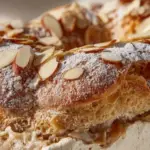
Paris-Brest
Ingredients
For the choux pastry:
• ½ cup (1 stick / 115g) unsalted butter
• 1 cup (240ml) water
• ¼ tsp salt
• 1 tbsp granulated sugar
• 1 cup (125g) all-purpose flour
• 4 large eggs
For the praline cream (mousseline):
• 2 cups whole milk
• ½ vanilla bean (split) or 1 tsp vanilla extract
• 3 large egg yolks
• ½ cup (100g) granulated sugar
• 3 tbsp (25g) cornstarch
• ½ cup (115g) unsalted butter, softened
• ½ cup (120g) praline paste (or ¼ cup almond butter + 2 tbsp powdered sugar + 1 tbsp honey if unavailable)
For garnish:
• Powdered sugar
• Sliced almonds (optional)
Instructions
- Choux pastry: Preheat oven to 375°F (190°C). Line baking sheet with parchment.
- In saucepan, bring butter, water, salt, and sugar to boil. Remove from heat; add flour all at once. Stir vigorously until smooth and forms a ball.
- Return to low heat; cook 1–2 min, stirring, to dry dough. Transfer to bowl.
- Add eggs one at a time, beating well after each, until glossy and thick.
- Pipe into a 6″ ring (or two 4″ rings) using a star tip. Brush with egg wash. Sprinkle with sliced almonds if desired.
- Bake 30–35 min until deep golden and hollow-sounding. Cool completely.
- Praline cream:
- Heat milk and vanilla until steaming. Whisk yolks, sugar, and cornstarch; slowly pour in hot milk. Return to pan; cook 2–3 min until thick.
- Press through sieve; cool with plastic wrap on surface.
- Beat in softened butter until smooth. Fold in praline paste.
- Assemble:
- Slice choux ring horizontally. Pipe or spread praline cream onto bottom half. Top with lid. Dust generously with powdered sugar.
PREP TIME & NUTRITION (per serving, serves 6):
Prep Time: 40 min | Cook Time: 35 min | Total Time: 2 hr (incl. cooling) | Servings: 6 | Calories: 480 | Net Carbs: 32g | Fats: 34g | Protein: 8g