
Greek Salad, known in Greece as Horiatiki Salata, is a celebration of simplicity, freshness, and high-quality ingredients. Unlike many international versions, traditional Greek salad contains no lettuce, no heavy dressings, and no unnecessary extras. Instead, it relies on ripe tomatoes, crisp cucumbers, briny olives, creamy feta, and fragrant oregano—brought together with excellent olive oil.
This classic dish represents the heart of Greek cuisine: honest food made with seasonal ingredients and minimal manipulation. In this guide, you’ll learn how to prepare authentic Horiatiki salad, understand why each ingredient matters, and master the technique that keeps it bright, juicy, and perfectly balanced.
What Is Traditional Greek Salad (Horiatiki)?
Horiatiki literally means “village-style,” reflecting its rustic origins. It’s a staple across Greece, especially during the summer months when tomatoes and cucumbers are at their peak.
Authentic Greek salad includes:
- Tomatoes
- Cucumbers
- Green bell pepper
- Red onion
- Kalamata olives
- A slab of feta cheese
- Olive oil
- Dried oregano
That’s it. No vinegar-heavy dressing, no lettuce, and no mixing the feta into crumbles.
Why Authentic Greek Salad Has No Lettuce
In Greece, lettuce is never used in horiatiki. Lettuce:
- Waters down flavor
- Competes with tomatoes
- Adds unnecessary bulk
Greek salad is meant to be juicy, crisp, and bold, with vegetables that hold their structure and complement each other naturally.
Why Make Greek Salad the Traditional Way?
Making authentic Greek salad ensures:
- True Mediterranean flavor
- Better texture and balance
- Respect for traditional cuisine
- Cleaner, fresher taste
- Fewer ingredients with more impact
When done correctly, Greek salad doesn’t need embellishment—it stands on its own.
Ingredients for Traditional Greek Salad (Horiatiki)
Core Ingredients
- 4 ripe tomatoes, cut into wedges
- 1 large cucumber, thickly sliced
- ½ green bell pepper, sliced
- ½ red onion, thinly sliced
- ½ cup Kalamata olives
- 4–6 oz block of feta cheese
Seasoning
- 3–4 tablespoons extra-virgin olive oil
- 1 teaspoon dried oregano
- Salt, to taste
Optional: A splash of red wine vinegar (used sparingly in some regions)
Choosing the Best Ingredients
Tomatoes
- Ripe, seasonal tomatoes are essential
- Avoid watery or underripe tomatoes
Cucumbers
- English or Persian cucumbers are ideal
- Leave the skin on for crunch
Feta Cheese
- Use Greek feta made from sheep’s milk
- Always use a block, never pre-crumbled
Olives
- Kalamata olives are traditional
- Keep them whole or lightly crushed
Olive Oil
- Use high-quality extra-virgin olive oil
- This is a key flavor, not just a dressing
Step-by-Step Instructions
Step 1: Prepare the Vegetables
Cut tomatoes into large wedges and place them in a wide serving bowl. Slice cucumber into thick rounds or half-moons. Add bell pepper and red onion.
The cuts should be rustic, not delicate.
Step 2: Add Olives
Scatter Kalamata olives evenly over the vegetables.
Step 3: Season Lightly
Sprinkle a small pinch of salt over the vegetables (feta and olives are already salty).
Step 4: Add Feta
Place a large slab of feta directly on top of the salad. Do not crumble.
Step 5: Dress Simply
Drizzle generously with olive oil and sprinkle dried oregano over the feta.
Step 6: Serve Immediately
Do not toss before serving. Diners break the feta and mix gently at the table.
Flavor and Texture Profile
Authentic Greek salad should be:
- Juicy from tomatoes
- Crisp from cucumber and pepper
- Briny from olives and feta
- Fragrant with oregano
- Rich but clean from olive oil
Every bite should taste fresh and balanced.
Common Mistakes and How to Avoid Them
Using lettuce: Not authentic
Overdressing: Masks natural flavors
Crumbling feta: Loses texture and visual appeal
Too much vinegar: Overpowers vegetables
Underripe tomatoes: Results in bland salad
Greek Salad vs International Versions
| Feature | Traditional Horiatiki | International Versions |
|---|---|---|
| Lettuce | No | Often included |
| Feta | Large slab | Crumbled |
| Dressing | Olive oil & oregano | Heavy vinaigrette |
| Add-ins | None | Chickpeas, avocado, etc. |
The traditional version is simpler—and better.
How to Serve Greek Salad
Greek salad is typically served:
- As a starter
- Alongside grilled meats or fish
- With crusty bread
- As part of a mezze spread
- At room temperature
It pairs beautifully with lamb, chicken souvlaki, and seafood.
Storage and Make-Ahead Tips
Best Practice
Greek salad is best eaten fresh.
Short Storage
If needed, store without feta for up to 12 hours in the refrigerator.
Avoid Freezing
Freezing ruins texture and flavor.
Nutritional Benefits of Greek Salad
Greek salad is:
- Naturally gluten-free
- Low in carbohydrates
- Rich in antioxidants
- High in healthy fats
- Suitable for Mediterranean diets
It’s filling without being heavy.
Frequently Asked Questions
Q1: Can I add vinegar?
Yes, but use sparingly—olive oil is the star.
Q2: Why is feta served on top?
Traditionally, it stays intact to preserve texture.
Q3: Can I use black olives instead of Kalamata?
Kalamata olives are preferred for authenticity.
Q4: Should the salad be tossed?
Not before serving.
Q5: Is Greek salad vegan?
Not traditionally, due to feta.
Why This Greek Salad Recipe Works
- Authentic ingredient list
- Proper cutting technique
- Minimal seasoning
- Respect for tradition
- Perfect balance of flavors
This is Greek salad as it’s meant to be enjoyed.
Conclusion
Greek Salad (Traditional Horiatiki) is proof that the simplest recipes are often the most powerful. With ripe vegetables, quality feta, fragrant oregano, and excellent olive oil, this iconic dish delivers freshness, balance, and authenticity in every bite.
When prepared the traditional way, Greek salad isn’t just a side dish—it’s a celebration of Mediterranean living.
Print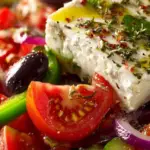
Greek Salad (Traditional Horiatiki): Fresh, Authentic, and Timeless
Ingredients
🥗 (Serves 4 as a side, 2 as a light meal)
• 3–4 ripe but firm tomatoes, cut into wedges (heirloom or beefsteak preferred)
• 1 cucumber, thickly sliced, then quartered (peeled partially in stripes, traditional style)
• 1 green bell pepper, seeded and cut into rings
• ½ red onion, thinly sliced into half-moons
• 1 cup Kalamata olives, pitted (leave some whole, some halved)
• 200g (7 oz) block of feta cheese—not crumbled! Place whole on top
• 2–3 tbsp extra-virgin olive oil (Greek, first cold-pressed)
• 1 tsp dried oregano (wild, Greek if possible)
• Sea salt to taste
• Optional: 1 tsp capers, or a few thin slices of fresh chili
CRUCIAL NOTES (Authenticity Matters!):
✔️ No lettuce. Ever. (That’s American “Greek” salad.)
✔️ No vinegar or lemon juice. The tomatoes provide natural acidity.
✔️ Feta stays whole—drizzled, not tossed—so it stays creamy and doesn’t dissolve.
✔️ Oregano is sprinkled after oil, so it “blooms” in the fat.
Instructions
- In a wide, shallow bowl (traditionally ceramic), gently combine tomatoes, cucumber, pepper, onion, and olives.
- Place the block of feta on top—not buried, but crowning the salad.
- Drizzle generously with olive oil.
- Sprinkle with oregano and a pinch of sea salt (go light—feta and olives bring saltiness).
- Let sit 10–15 min at room temperature before serving—this allows flavors to marry.
- At the table, break the feta with a fork and toss lightly as you serve.
PREP TIME & NUTRITION :
Prep Time: 10 min (+15 min rest) | Total Time: 25 min | Servings: 4
Calories: 220 | Net Carbs: 6g | Fats: 18g | Protein: 7g