
Tabbouleh salad is a bright, refreshing Middle Eastern classic celebrated for its vibrant herbs, juicy tomatoes, and zesty lemon dressing. Unlike grain-heavy salads, authentic tabbouleh places parsley at the center, with bulgur wheat playing a supporting role. The result is a light yet satisfying dish that’s crisp, aromatic, and incredibly nourishing.
Often served as part of a mezze spread, tabbouleh is naturally vegan, packed with nutrients, and bursting with fresh flavor. This guide will show you how to make classic tabbouleh salad the traditional way, explain ingredient ratios, and share expert tips to achieve perfect balance every time.
What Is Tabbouleh Salad?
Tabbouleh (also spelled tabbouli or tabouli) is a Levantine salad originating in Lebanon and Syria. It’s traditionally made with:
- Fresh parsley (the star ingredient)
- Mint
- Tomatoes
- Fine bulgur wheat
- Lemon juice
- Olive oil
Authentic tabbouleh is green and herb-forward, not grain-based. The herbs provide texture, aroma, and freshness, while lemon and olive oil bring brightness and richness.
Why Authentic Tabbouleh Uses Mostly Herbs
In traditional Lebanese cuisine, tabbouleh is valued for its freshness and digestive qualities. Parsley provides:
- Bright, grassy flavor
- High vitamin C and antioxidants
- A crisp, refreshing bite
Bulgur is used sparingly—just enough to absorb dressing and provide subtle texture.
Why Make Homemade Tabbouleh?
Homemade tabbouleh offers clear advantages:
- Superior freshness
- Proper herb-to-grain ratio
- Balanced acidity
- No soggy texture
- Customizable seasoning
- Far more authentic flavor
Once you try true herb-forward tabbouleh, you’ll never go back to heavy, grainy versions.
Ingredients for Classic Tabbouleh Salad
Core Ingredients
- 4 cups fresh flat-leaf parsley, finely chopped
- ½ cup fresh mint leaves, finely chopped
- 3 ripe tomatoes, finely diced
- ¼ cup fine bulgur wheat (soaked)
- 4 green onions, finely sliced
Dressing
- ¼ cup fresh lemon juice
- ¼ cup extra-virgin olive oil
- 1 teaspoon salt
- ½ teaspoon black pepper
- ¼ teaspoon allspice or cinnamon (optional)
Choosing the Right Ingredients
Parsley
- Use flat-leaf (Italian) parsley, not curly
- Leaves only—discard thick stems
- Chop finely with a sharp knife
Mint
- Adds freshness and aroma
- Use sparingly to avoid overpowering
Bulgur
- Use fine bulgur (#1)
- Do not cook—soak briefly in lemon juice
Tomatoes
- Firm, ripe tomatoes
- Remove watery seeds for best texture
Step-by-Step Instructions
Step 1: Soak the Bulgur
Place bulgur in a small bowl and cover with lemon juice. Let soak for 10–15 minutes until softened. Drain excess liquid if needed.
Step 2: Prep the Herbs
Wash parsley and mint thoroughly. Dry completely using a salad spinner or towels. Finely chop using a sharp knife.
Dry herbs are essential—wet herbs dilute flavor and cause sogginess.
Step 3: Chop Vegetables
Finely dice tomatoes and slice green onions. Uniform size ensures even distribution.
Step 4: Combine Ingredients
In a large bowl, combine parsley, mint, tomatoes, onions, and soaked bulgur.
Step 5: Dress the Salad
Add olive oil, salt, pepper, and optional spice. Toss gently until evenly coated.
Step 6: Rest Briefly
Let tabbouleh rest for 10 minutes before serving to allow flavors to meld.
Texture and Flavor Profile
Perfect tabbouleh should be:
- Bright green
- Light and crisp
- Juicy but not watery
- Herbaceous and lemony
- Balanced with subtle richness from olive oil
Common Mistakes and How to Avoid Them
Too much bulgur: Overpowers herbs
Wet herbs: Results in soggy salad
Dull flavor: Needs more lemon or salt
Mushy texture: Tomatoes too watery
Chopped too coarsely: Lacks elegance
Traditional vs Modern Variations
Traditional Lebanese Tabbouleh
- Parsley-dominant
- Fine bulgur
- Simple seasoning
Modern Variations
- Quinoa instead of bulgur
- Cucumber addition
- Pomegranate seeds
- Extra spices
While variations are popular, the classic version remains unmatched.
How to Serve Tabbouleh
Tabbouleh is traditionally served:
- As part of a mezze platter
- With hummus, baba ganoush, and pita
- Scooped with romaine lettuce leaves
- Alongside grilled meats
- As a refreshing side dish
It pairs beautifully with rich and smoky foods.
Storage and Make-Ahead Tips
Refrigeration
Best eaten fresh, but can be stored up to 24 hours.
Make-Ahead Strategy
Prep herbs and vegetables separately, then combine just before serving.
Freezing
Not recommended—texture will suffer.
Nutritional Benefits of Tabbouleh
Tabbouleh is:
- Low-calorie
- High in fiber
- Rich in antioxidants
- Naturally vegan
- Gluten-free if made without bulgur
Parsley alone provides vitamin K, vitamin C, and iron.
Frequently Asked Questions
Q1: Can I make tabbouleh without bulgur?
Yes—omit or replace with quinoa.
Q2: Why is my tabbouleh watery?
Wet herbs or overly juicy tomatoes.
Q3: Can I use curly parsley?
Flat-leaf is strongly recommended.
Q4: How fine should I chop the herbs?
Very fine for authentic texture.
Q5: Is tabbouleh healthy?
Yes—nutrient-dense and plant-based.
Why This Tabbouleh Recipe Works
- Correct herb-to-grain ratio
- Proper soaking method
- Balanced lemon and olive oil
- Authentic preparation
- Clean, fresh flavors
This recipe honors traditional Middle Eastern technique.
Conclusion
Tabbouleh salad is a celebration of freshness, simplicity, and balance. With vibrant herbs, bright lemon, and just enough bulgur to bring it together, this classic dish proves that the best recipes rely on quality ingredients and thoughtful preparation.
Once you experience authentic tabbouleh, it becomes an essential part of your kitchen repertoire.
Print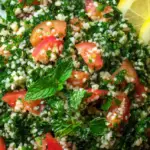
Tabbouleh Salad: Fresh, Herb-Forward, and Authentically Mediterranean
Ingredients
• 2 cups finely chopped fresh parsley (stems removed—yes, this is the STAR!)
• ½ cup finely chopped fresh mint
• 1 cup cucumber, finely diced
• 1 cup cherry tomatoes, quartered
• ¼ cup red onion, very finely minced (soak in cold water 5 min to mellow, then drain)
• 2 tbsp extra-virgin olive oil
• 3 tbsp fresh lemon juice
• ½ tsp sea salt
• ¼ tsp black pepper
• Optional: ¼ cup toasted pine nuts or hemp seeds for crunch
LOW-CARB “BULGUR” OPTION (adds texture without grains):
→ Replace traditional bulgur with ½ cup riced cauliflower (steamed 3 min + squeezed very dry) or ¼ cup soaked hemp seeds (adds protein + nuttiness).
Instructions
- In a large bowl, combine parsley, mint, cucumber, tomatoes, and drained red onion.
- In a small jar, shake olive oil, lemon juice, salt, and pepper.
- Pour dressing over salad; toss gently but thoroughly.
- Fold in riced cauliflower or hemp seeds (if using) and optional pine nuts.
- Chill 20–30 min before serving—allows flavors to meld without wilting herbs.
PREP TIME & NUTRITION :
Prep Time: 20 min (+30 min chill) | Total Time: 50 min | Servings: 6 (¾-cup)
Calories: 75 | Net Carbs: 4g | Fats: 6g | Protein: 2g